
Hand a child a blank journal at the end of a long travelling day and watch what happens. They stare at the page, write “today was fun”, and close it.
It is not that they have nothing to say. It is that “write about your day” is far too big a question, and a blank page is intimidating at any age.
The usual fix is a spotting list: find a dung beetle, find a padstal, tick them off. That works for about three days, and then it is finished. You cannot find your first padstal twice.
What lasts is a different kind of question, and there are twenty of them below.
Why the same question works again and again
Ask a child “what could you hear when everyone stopped talking?” on a game drive at six in the morning and you get lions calling, doves, a hyena somewhere, people whispering.
Ask exactly the same question four days later on a beach and you get surf, wind, gulls, kids shouting in the distance. Ask it on a mountain path and you get almost nothing at all, which is its own answer.
One question, three completely different days, and a child who has started comparing them without being told to. That is the whole trick. Questions about the senses never run out, because the senses meet something new everywhere you take them.
They also work for any age. A seven-year-old answers “what did today smell like?” in three words and a twelve-year-old writes a paragraph, and both of them have properly noticed something.
What to Write in a Travel Journal: 20 Prompts Kids Can Use Again and Again
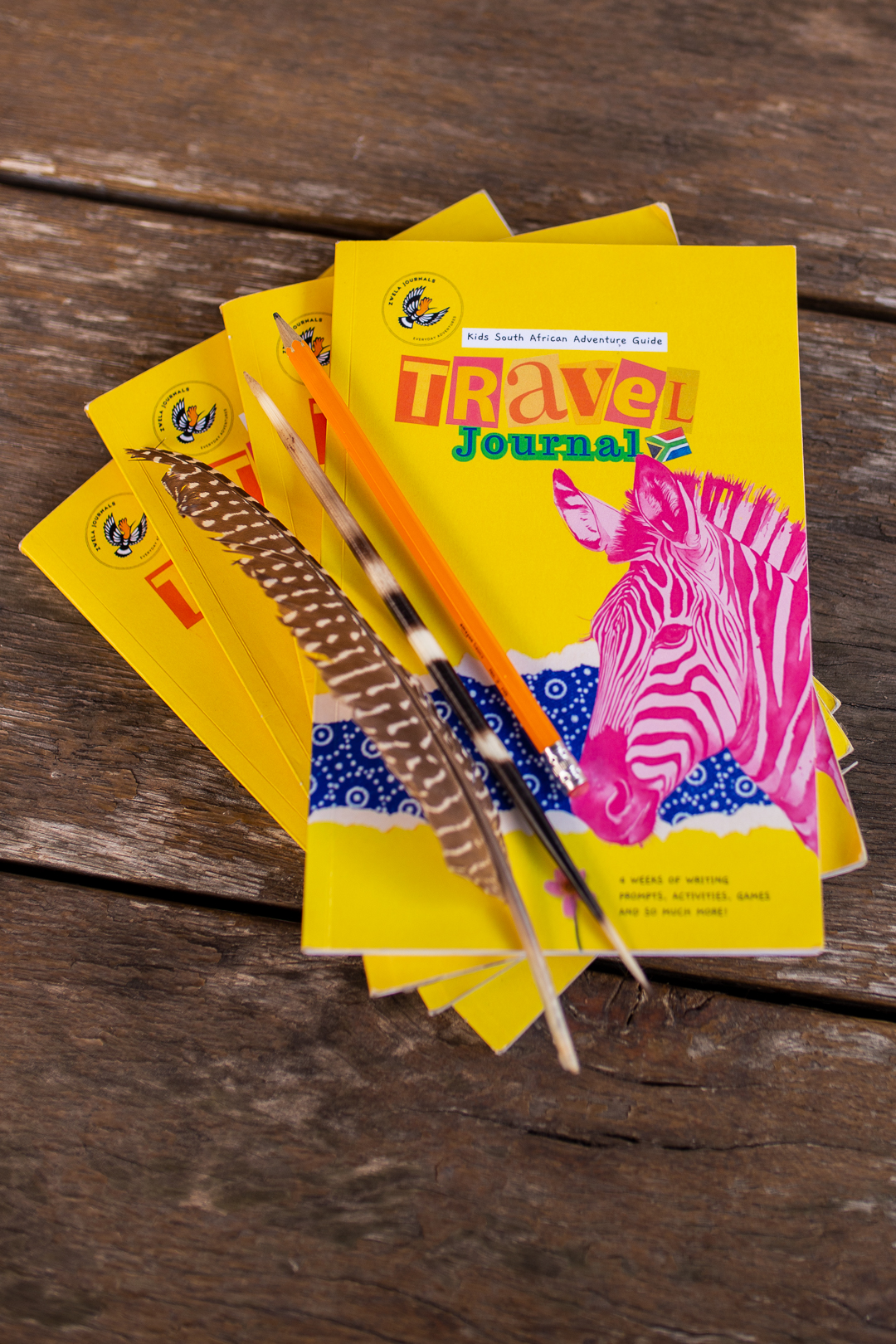
Each one comes with the sort of answer it tends to produce in South Africa, though that is only a hint. The point is that they work anywhere you go. Head to our Kids Travel Resources section to download a list of 30 questions in printable format, that you can print and tuck into their journal… and grab a Zwela Journal while you are at it, its these kind of prompts that make our journals stand out from the rest!
- What could you hear when everyone stopped talking? The best question on this list. Lions before dawn, surf, wind in a fever tree, absolutely nothing.
- What did today smell like? Dust after rain, woodsmoke from a braai, salt, sun cream, hot tar.
- What was the smallest living thing you saw? A dung beetle, an ant lion pit, a gecko on a wall, a beetle in the tent.
- What was the furthest thing you could see? A mountain nobody could name, a storm coming across the Karoo, a ship.
- What colour was the ground today? It genuinely changes: red, grey, gold, white sand, black rock.
- What woke you up? A bird you could not identify, the person next door, a baboon on the roof, an alarm at half past four.
- Something you touched that you have never touched before. Kelp, an elephant footprint, a thorn, water far colder than expected.
- Was today hot, cold, wet, dusty, or all four? On a South African road trip it is often all four before lunch.
- Something you tasted for the first time, and an honest verdict. Biltong, rooibos, a koeksister, something on the braai nobody could name.
- What was moving that nobody else noticed? Trains children to look rather than be shown.
- A word you heard today that you did not understand. Write it down the way it sounded, then find out what it means.
- What was the loudest thing today? Often not what anyone expects.
- Draw one thing exactly the size it looked from where you were standing. A giraffe from fifty metres is smaller than children think, and they enjoy being wrong about it.
- What did the water feel like? Two oceans, a tidal pool, a hotel pool, a river. All different, all worth recording.
- What surprised you today? The one that produces the answers you never see coming.
- What was the best five minutes of today? Better than asking about the best day, because five minutes is a real memory rather than a summary.
- Who did you meet, and what did they tell you? Guides, the person who filled the car, a child on a beach.
- What would you tell someone at home about first? Reveals what actually landed, which is rarely the expensive part.
- What do you want to see again tomorrow? Turns the journal forwards instead of only backwards.
- What are you grateful for today? Ask it every single night. It is the one that changes how children look at the whole trip.
How to use them
A few things make the difference between something a child uses and something abandoned on day three.
Ask two or three, not twenty. Pick a couple in the morning so they spend the day gathering answers, and one at night. A list produced at bedtime is a test. A question produced at breakfast is a treasure hunt.
Repeat them deliberately. The same question in the bush, at the coast and in a city is the point, not a failure of imagination. Comparing the three answers is where the noticing actually happens.
Let drawings count. A bad sketch of a dung beetle is a perfectly valid answer, and children who cannot yet write fluently should not be shut out of this.
Do it in the middle of the day. On safari especially, the hot hours between drives are the natural moment. Everyone is sitting down, nothing is happening, and the morning is still fresh.
Answer them yourself too. Children write far more when the adults are writing as well, and your answers will be different from theirs, which they find fascinating.
A good question is only half of it
Here is the part that catches families out. A question tells a child what to notice. It does not tell them where the answer goes.
A blank notebook does not solve that, because a blank page is exactly the problem we started with. Loose paper gets lost by day four. A note on somebody’s phone is not theirs and will never be read again.
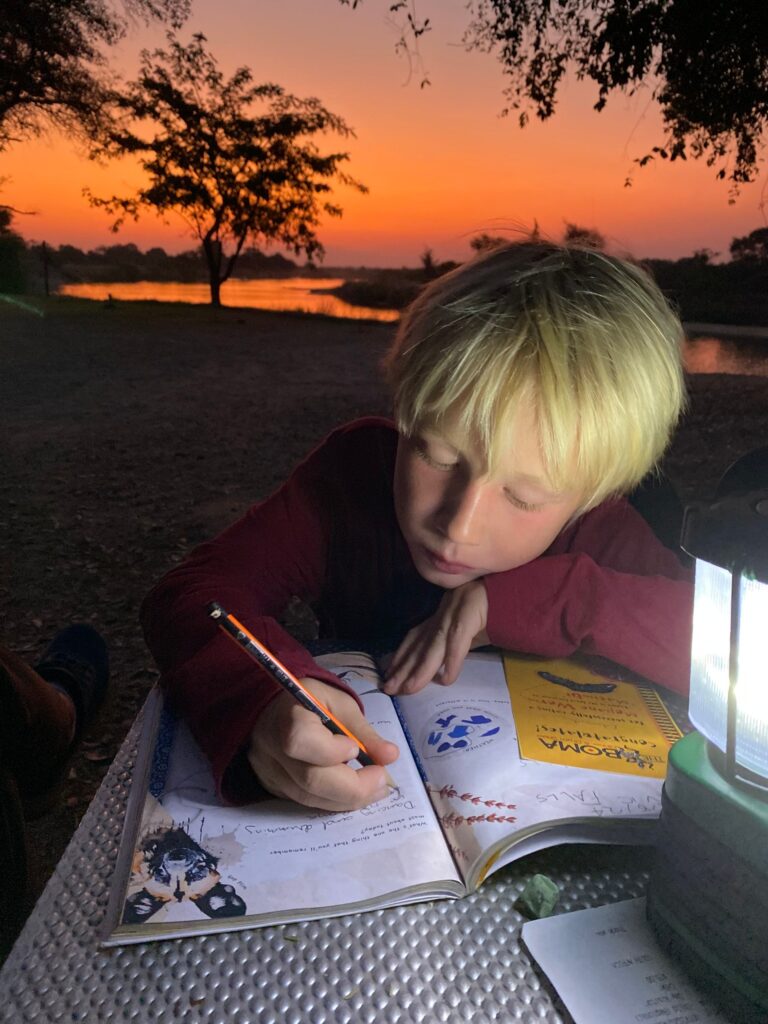
What children need is somewhere the question has already been asked, so all they have to do is answer it, and somewhere the answers stay in order so that six months later the whole trip is still sitting there in sequence.
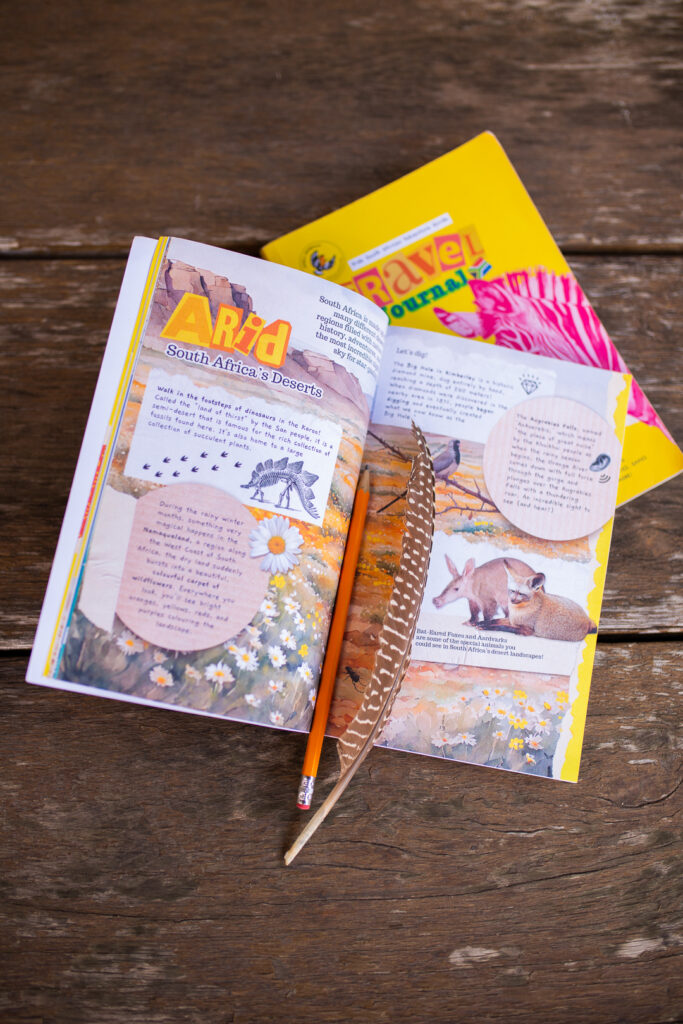
What is inside the South African Travel Journal
This is the reason we made ours, and it is built around one trip to one country rather than being a general-purpose diary.
It runs to 126 full-colour pages, for ages seven to twelve, in paperback or hardcover.
- Maps and dreams. South African maps to plan the journey on, and bucket-list pages that run from Cape Town to Kruger.
- Guides and discoveries. The landscapes, from beach to bush to mountain, the Big Five and the wildlife beyond it, and pages on the food, the culture and the languages.
- Prompts and reflection. Four weeks of prompted journal pages with a daily gratitude check-in, and room for drawings, doodles and photographs.
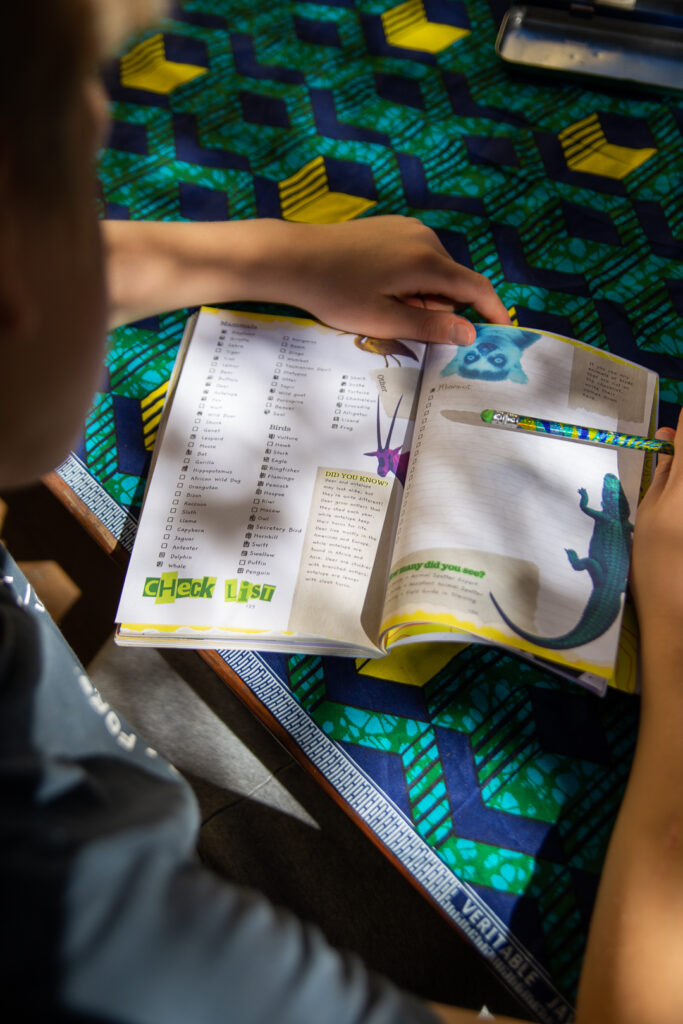
- Checklists. Wildlife lists made for ticking off from a moving car, which is the bit children reach for first.
- Games and play. Road-trip games, mazes, code-breaking puzzles, scavenger hunts and colouring pages, for the long drives and the hot afternoons.
That last part matters more than it sounds. Children will not carry three separate things, and they will not fill in a journal that is only a journal. It has to earn its place in the bag on the days when nobody feels like writing, which is why ours is a travel guide, an activity book and a keepsake at the same time.
Our honest view
Children do not forget a trip because it was not memorable. They forget it because nobody gave them a way to hold onto it while it was happening, and an unrecorded holiday compresses very fast into “we saw elephants”.
Start with three of the questions above. Ask them tomorrow, ask the same three again next week somewhere completely different, and let your child hear how differently they answer.
Take note of the little things, celebrate the big things. The little things are what the senses catch, and they are almost always the ones children still have years later.
You can see the whole journal on our South African Travel Journal page.
If you are still planning the trip itself, our complete family travel guide to South Africa covers the route, our month-by-month guide covers the timing, and safari with kids is where these questions do their best work.